LAB
Audax · Agentic Collaboration
An open lab for agentic collaboration between organisations — shared AI agents that make a distributed community's work visible, connected, and easy to act on. First build: ARKo the Agent.
↓ Enter the LabOpen Enquiry Nº 01
How can AI help a group of independent, purpose-aligned organisations move from being a network of connected projects to becoming an ecosystem capable of sensing, learning, and acting together?
The question behind the lab
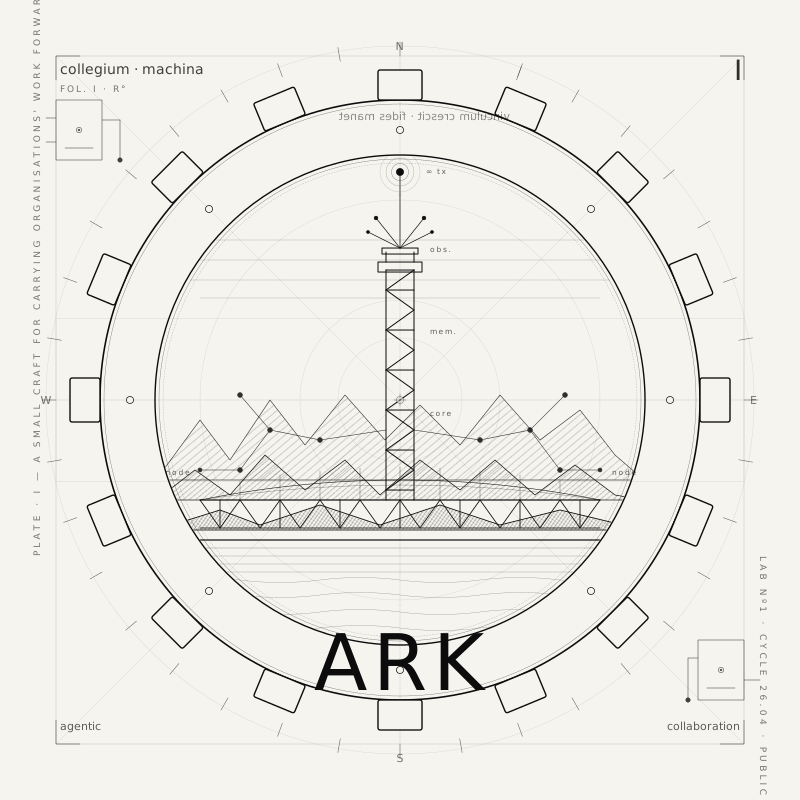
A small craft for carrying organisations' work forward, together.
From connected organisations to a sensing ecosystem.
Purpose-driven organisations are already surrounded by potential allies.
They attend the same gatherings. They know many of the same people. They work on adjacent problems. They share values, tools, methods, funders, technologies, and ambitions.
Yet collaboration remains difficult.
One organisation is looking for a technical partner while another has already built most of what it needs. One project is searching for a pilot site while another is looking for a meaningful use case. Several teams encounter the same organisational problem but solve it separately. Important learning appears in project updates, blog posts, podcasts, GitHub repositories, and social feeds, then quietly disappears beneath the next wave of information.
Networks help organisations find one another.
They do not automatically help them sense, remember, and act together.
Audax OS has been exploring the possibility that agentic inter-organisational communication could create a new collective-intelligence layer: agents distilling public signals, sharing relevant context, surfacing needs and offers, and helping organisations recognise opportunities they would otherwise miss.
ARK is the first attempt to make that proposition tangible.
Open Enquiry Nº 03
What happens when aligned organisations become more legible to one another, and their agents begin helping them discover where shared action is possible?
Legibility · shared action
A lab for agentic collaboration.
Audax Lab №1 is a small working group building agentic collaboration between organisations — shared AI agents that make the public work of a distributed community visible, understandable, and connected, so that people and organisations can find each other and act on what they learn.
Memory and knowledge infrastructure aren't the point — they're the tool. A shared agent has to remember what each organisation is doing, reason over it faithfully, and share it without confusing whose it is; that engineering problem is where most of our research effort goes, in service of the collaboration the agent is actually for.
The work is grounded in two long-running research threads — The Coherence Company (transcript-native institutional intelligence, dreaming architectures, the Living Book) and Regentribe (decentralized knowledge infrastructure on Radicle and SurrealDB) — and in one live build, ARKo the Agent, our first attempt to put agentic collaboration into practice.
Open Enquiry Nº 05
Can agents make the public voices of organisations more mutually intelligible — and more useful to one another?
Intelligibility · mutual use
The first build: ARKo the Agent.
What might become possible when organisations do not only communicate through meetings, newsletters, Slack channels, and the occasional heroic connector, but also through agents capable of sensing opportunities across the wider field?
This is the question behind the ARK Hackathon, the first concrete experiment of Audax Labs.
Audax Labs is the experimental engine of Audax OS: an open environment where organisations, builders, researchers, and practitioners can test the infrastructure required for distributed, fractional, purposeful, and increasingly agentic collaboration.
ARK begins with one bounded challenge:
Can a shared agent help a small ecosystem of aligned organisations understand what is happening across the field, discover opportunities for collaboration, and develop a more coherent shared narrative?
This is not yet an attempt to build a complete inter-organisational operating system. It is the first practical step toward one.
→ Read the invitation — what we're building, the schedule, what we ask of participating organisations, and how to RSVP.
Open Enquiry Nº 07
Can agents identify meaningful collaboration opportunities rather than merely superficial thematic overlap?
Discernment · signal over surface
A commons and a portfolio.
Everything in this repository is released under CC0 1.0 Universal — a public domain dedication. No copyright is asserted. No attribution is required. Contributions you make become part of the commons; do not contribute material you cannot release that way.
The choice is deliberate. A commons, because every artifact here is dedicated to the public domain so anyone can build on it. A portfolio, because everything you write here is signed by your commits and visible to anyone who wants to see how you think — your research, your syntheses, your judgment under uncertainty, the questions you choose to chase.
We work in the open so we can show our thinking, share research and synthesis, learn together, and show what each of us is capable of. Both readings are intended. Contribute work you would be proud to put your name on, and contribute it in a way that helps the next person.
Still Open
Nº 09
Can agents reduce duplicated work by revealing where organisations are solving similar problems independently?
Duplication · parallel effort
Nº 10
How can agents support mutual learning, peer review, and the exchange of technical and organisational practices across value-aligned organisations?
Learning · peer review · practice exchange
Open Channel · Telegram
Join the lab.
A small group meets — mostly — in the channel: people building shared agents for their organisations, and the collaboration those agents are meant to unlock. Drop in.
Join on Telegram↗ t.me · private invitation · readers welcome